Barry, OppHub America Desk · · Source: yahoo-tickers-tape-movers
AVGO AI Revenue Surge: Broadcom vs TSMC Capital Model
If custom demand continues to outpace foundry bottlenecks, watch because fabless design avoids heavy plant-and-equipment cash burn. Chips & export controls: Export controls and industrial policy are direct semis catalysts.
Based on reporting from yahoo-tickers-tape-movers.
Broadcom (NASDAQ: AVGO) is flexing a fabless AI chip design model that generated $26.9 billion in fiscal 2025 free cash flow on minimal capital expenditure, contrasting sharply with Taiwan Semiconductor's heavy foundry infrastructure spending. Investors tracking artificial intelligence hardware anchors are weighing Broadcom's upcoming absolute reporting date on Wednesday, December 9, 2026.
Market context for this story
As of: PremarketLoading quotes…
Informational only — not investment advice. Full markets →


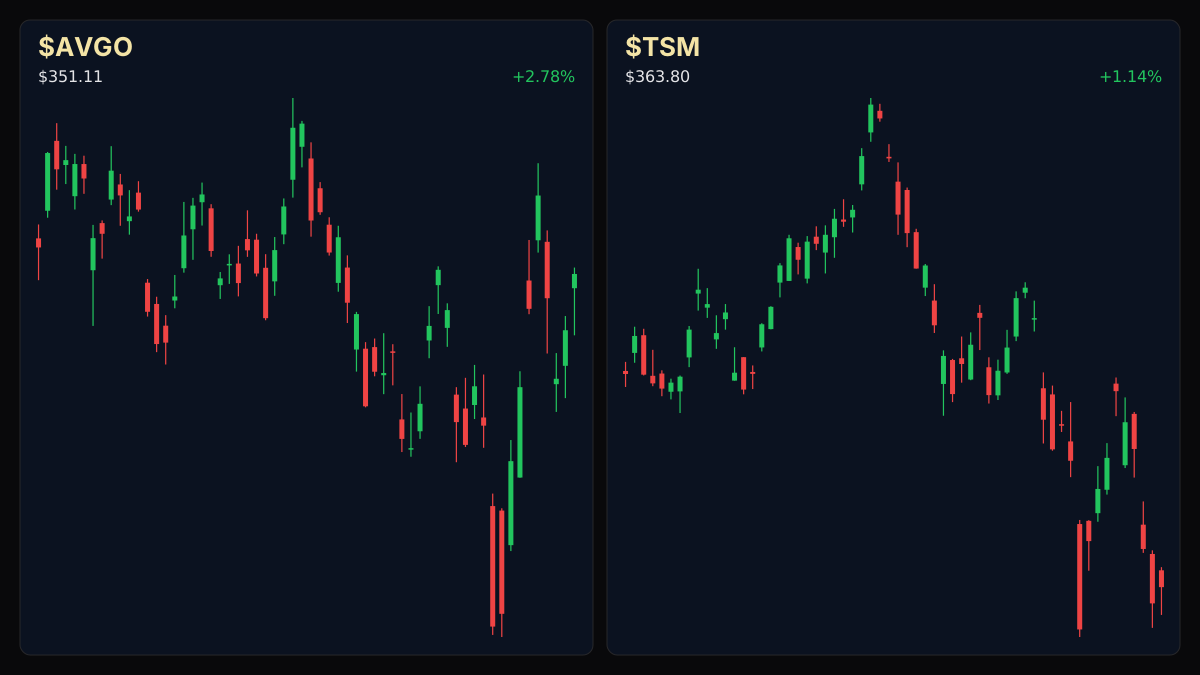
$AVGOBroadcom
TradingView
Live chart & market data via TradingView · OppHub classroom · Delayed or exchange real-time per TradingView data agreements · Not investment advice
$TSM
TradingView
Live chart & market data via TradingView · OppHub classroom · Delayed or exchange real-time per TradingView data agreements · Not investment advice
Educational TradingView charts — search any symbol in the widget. Confirm on /markets/AVGO and related $TSM, $GOOGL, $META. Not investment advice.
Related markets
Shares a vertical MP4 loop to your phone's camera roll or app share sheet (Instagram, TikTok, Facebook Reels).
Broadcom (NASDAQ: AVGO) designs high-performance AI semiconductors while outsourcing capital-heavy fabrication, yielding $26.9 billion in fiscal 2025 free cash flow on just $623 million of capex as custom XPUs drive massive tape volume.
### Money Play - If custom XPU demand continues to outpace foundry bottlenecks, watch $AVGO+WL because fabless design avoids heavy plant-and-equipment cash burn. - Chips & export controls: Export controls and industrial policy are direct semis catalysts. - Prior portfolio adjustments highlight how institutional capital flows target infrastructure leaders; see our previous coverage at /explore/avgo-mu-portfolio-adjustments-highlight-etf-reallocation.
## Catalyst Analysis: Fabless Model vs Foundry Intensity Broadcom reported that its AI semiconductor revenue reached $16.70B, up 221% year-over-year, with custom XPUs making up 73% of that total. This design engine operates at foundry scale, contrasting with Taiwan Semiconductor's $13.8 billion quarterly capex and ongoing 2.5 billion node investments.
The divergence in capital allocation highlights distinct risk-reward profiles for market participants. Broadcom's asset-light design strategy generated $13.66 billion of free cash flow in Q3 alone—representing 46% of revenue—bringing the trailing four quarters to $39.4 billion. Meanwhile, Taiwan Semiconductor maintains a 2026 capital budget of $60 billion to $64 billion to support foundry scale across the wider technology sector.
Decisions around node transitions introduce variable gross margin dynamics across the semiconductor stack. Taiwan Semiconductor's 2.5/2nm ramp compressed its gross margin by 1.3 percentage points sequentially to 66.4%. Broadcom reports on Wednesday, December 9, 2026, with guided AI revenue expectations reaching $21.7 billion as multiple expansion hinges on whether gross margins hold near guided thresholds.
## $AVGO+WL Technical Analysis & Key Risk Watch
77.54 · R1 ## $AVGO+WL Technical Analysis & Key Risk Watch 63.20 · last ## $AVGO+WL Technical Analysis & Key Risk Watch 56.14 · S1 ## $AVGO+WL Technical Analysis & Key Risk Watch 55.01 · S2 ## $AVGO+WL Technical Analysis & Key Risk Watch 48.80.
### Story Arc / How We Got Here Building on prior institutional portfolio reallocations into hardware leaders on Monday, November 9, 2026—when Avantis U.S. Large Cap Value (DUHP) allocated millions into Broadcom and Micron—today's capital efficiency metrics reinforce why asset-light design remains a focal point for institutional portfolio construction ahead of the December reporting window.
### Sector Ripple / Impact on Semiconductors Custom XPU deployment directly connects Broadcom to hyperscale customers including Google, Meta, and OpenAI. Foundry dynamics at Taiwan Semiconductor influence overall component pricing and packaging availability across the broader artificial intelligence supply chain.
Read the full story
Original reporting and related coverage — attribution links only, not paid recommendations.
Trade this story
 Robinhood
 Webull
 Tradier
 IBKR
Chart this story
 TradingView
Broker and exchange buttons use invite / refer-a-friend links (rewards may be capped). Charting links (TradingView) are partner offers that may pay OppHub America a commission at no extra cost to you.
OppSHOP
Full OppSHOP →As an Amazon Associate, OppHub America earns from qualifying purchases. Shopping here helps keep the site free — at no extra cost to you. Disclosure

OppSHOP
Related to this story
If custom demand continues to outpace foundry bottlenecks, watch because
Shop related →

Investing books
Read the classics
Shop this pick →

Personal finance books
Run the household books
Shop this pick →

Trading notebooks
Write the thesis first
Shop this pick →

Monitor for charts
See every pane
Shop this pick →
Story playbook
A pre-built map of what to watch — stocks, ETFs, and educational next steps. Not personalized advice.
Snapshot date: November 18, 2026 at 10:16 AM ET
This playbook was built when the story published and is not live-updated. Prices, news, and risk can change after this date — treat it as a starting map, not a current trade ticket.
Story → money map
AI chips
Broadcom makes a lot of money designing AI chips without spending billions building expensive factories, unlike some of its partners. Investors care because keeping costs low leaves more cash in the company's pocket.
What changed
Broadcom's asset-light fabless model yielded record free cash flow, highlighting a stark contrast with foundry capital intensity ahead of its reporting date.
Who wins / who loses
Asset-light AI chip designers win on high free cash flow margins, while capital-heavy foundry infrastructure providers face massive plant-and-equipment cash burn.
Time horizon
Think in terms of the next few months.
Confidence & best fit
medium confidence · Long-term investor, Active trader
Safer theme exposure (ETFs)
Baskets that own the theme without betting on one company.
Single stocks (higher risk)
Primary = closest to the story · Peers = same industry · Second-order = knock-on effects · Avoid = looks related but may be a trap
Primary
- $AVGOWatch — track, don’t rush
Broadcom designs chips without owning factories, keeping expenses low and profits high.
View $AVGO chart → · End-of-day delayed data
Peer
- $TSMWatch — track, don’t rush
Taiwan Semiconductor spends billions building and maintaining actual manufacturing plants.
View $TSM chart → · End-of-day delayed data
- $MRVLWatch — track, don’t rush
Marvell also designs custom chips for big tech companies, following a similar playbook.
View $MRVL chart → · End-of-day delayed data
Second-order
- $NVDAWatch — track, don’t rush
Nvidia is the main giant in AI chips, so its health affects all other chip stocks.
View $NVDA chart → · End-of-day delayed data
Options (education only)
No strikes or expiries — a framework for how traders might express the view. Options can expire worthless.
Beginners should skip options around earnings announcements because sudden price swings can wipe out simple bets quickly.
See options-friendly brokers →Income / OppHub America angle
Not a trade tip — ways to use the insight outside the market.
- Monitor cloud provider capital expenditure announcements for clues on custom silicon adoption rates.
What would break this thesis
- A sudden slowdown in custom XPU orders or unexpected supply chain bottlenecks at foundries would invalidate the thesis.
What to do next on OppHub America
Saved playbooks stay on this device for now.
Important
Not financial advice. OppHub America playbooks are educational market maps only — not recommendations to buy, sell, or hold any security. Markets move fast; information can be wrong or outdated. Trade and invest at your own risk. Do your own research or consult a licensed advisor.
Aftermath · $NVDA
-3.32% vs write
- •Since this piece: $NVDA is down -3.32% vs $156.14 at write time (now $150.96).
- •Session move (Yahoo delayed): -2.89%.
- •RSI14 at write was 16 — compare levels on Markets, not advice.
- •Original money play lens: If custom demand continues to outpace foundry bottlenecks, watch because fabless design avoids heavy plant-and-equipment cash burn. Chips & export controls: Export controls and ind
- •Track $NVDA live on OppHub Markets (/markets/NVDA). Not financial advice.
Based on reporting from yahoo-tickers-tape-movers.
Informational and educational only — not investment, financial, or legal advice. Disclosure
Shares a vertical MP4 loop to your phone's camera roll or app share sheet (Instagram, TikTok, Facebook Reels).