Barry, OppHub America Desk · · Source: yahoo-tickers-tape-movers
Clark Howard Warns Savers on Low Bank Yields vs Treasury I Bonds
As retail savers weigh low-yielding bank accounts against government debt options, investors should assess cash allocation strategies in light of prevailing Treasury yields.
Based on reporting from yahoo-tickers-tape-movers.
Consumer money host Clark Howard warns depositors earning minimal yields at major institutions that alternative government instruments offer significantly higher returns. Savers evaluating low-yield cash accounts face a stark contrast against Treasury I bonds yielding 5.51%.
Market context for this story
As of: PremarketLoading quotes…
Informational only — not investment advice. Full markets →


$WFCWells Fargo
TradingView
Live chart & market data via TradingView · OppHub classroom · Delayed or exchange real-time per TradingView data agreements · Not investment advice
$CCitigroup
TradingView
Live chart & market data via TradingView · OppHub classroom · Delayed or exchange real-time per TradingView data agreements · Not investment advice
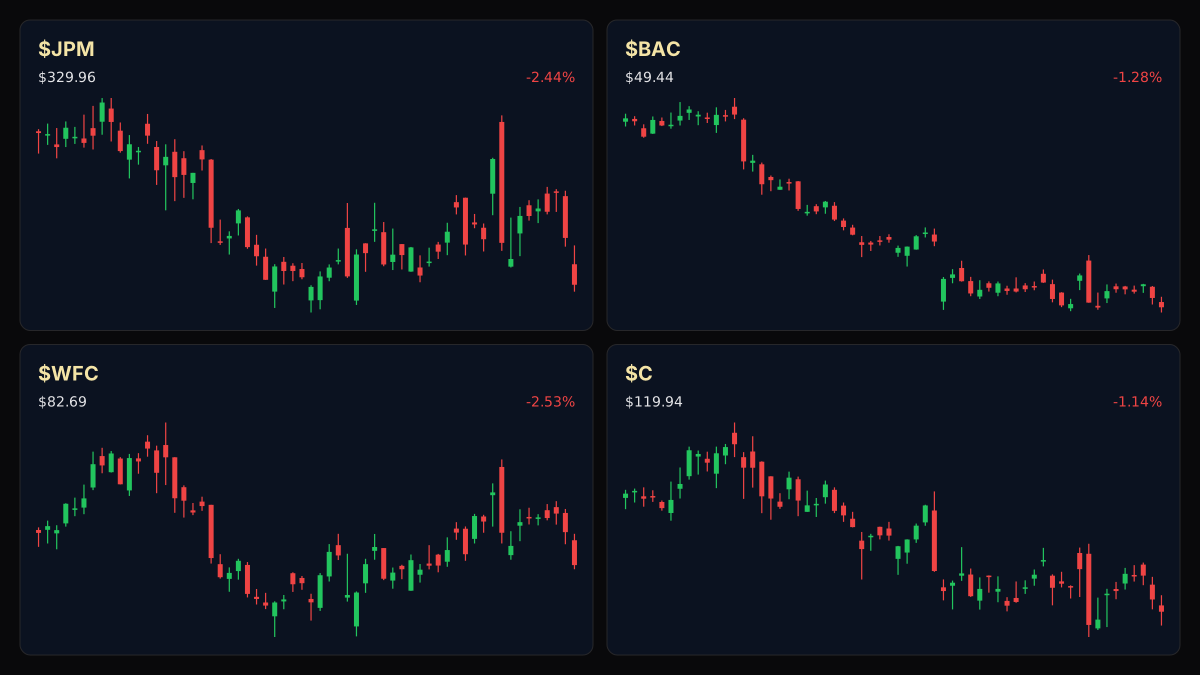
Educational TradingView charts — search any symbol in the widget. Confirm on /markets/WFC and related $C, $BAC, $JPM. Not investment advice.
Related markets
Shares a vertical MP4 loop to your phone's camera roll or app share sheet (Instagram, TikTok, Facebook Reels).
Consumer money host Clark Howard warned depositors earning minimal yields at major financial institutions that alternative government instruments offer significantly higher returns. Savers evaluating low-yield cash accounts face a stark contrast against Treasury I bonds yielding 5.51% through April 30, 2027.
### Money Play As retail savers weigh low-yielding bank accounts against government debt options, investors should assess cash allocation strategies in light of prevailing Treasury yields.
## Catalyst Analysis: Yield Disparity in Retail Savings Howard highlighted the disparity between typical large-institution savings accounts, which return roughly 1/100th of 1%, and U.S. Treasury I bonds paying 5.51%. For $10,000 deposited, traditional big-bank savings generate about $1 annually compared to roughly $551 for I bonds during a comparable period, assuming the rate holds.
The 5.51% rate combines a 1.4% fixed rate—which remains locked for the life of the bond—with a 2% semiannual inflation component. By comparison, FDIC national average 12-month CDs yield 1.8%, while 52-week Treasury bills recently yielded 4.55%.
## Technical Analysis & Key Risk Watch
Liquidity constraints remain the primary risk for savers shifting cash into I bonds. Treasury rules require funds to remain locked for at least 12 months, and cashing out before five years forfeits three months of interest. Consequently, emergency cash reserves require liquid online savings vehicles rather than short-term lockup instruments.
Read the full story
Original reporting and related coverage — attribution links only, not paid recommendations.
Trade this story
 Robinhood
 Webull
 Tradier
 IBKR
Chart this story
 TradingView
Broker and exchange buttons use invite / refer-a-friend links (rewards may be capped). Charting links (TradingView) are partner offers that may pay OppHub America a commission at no extra cost to you.
OppSHOP
Full OppSHOP →As an Amazon Associate, OppHub America earns from qualifying purchases. Shopping here helps keep the site free — at no extra cost to you. Disclosure

OppSHOP
Related to this story
As retail savers weigh low-yielding bank accounts against government deb
Shop related →

Investing books
Read the classics
Shop this pick →

Personal finance books
Run the household books
Shop this pick →

Trading notebooks
Write the thesis first
Shop this pick →

Monitor for charts
See every pane
Shop this pick →
Story playbook
A pre-built map of what to watch — stocks, ETFs, and educational next steps. Not personalized advice.
Snapshot date: November 18, 2026 at 5:01 AM ET
This playbook was built when the story published and is not live-updated. Prices, news, and risk can change after this date — treat it as a starting map, not a current trade ticket.
Story → money map
cash yields vs bank deposits
Big banks are paying almost zero interest on your savings, while government bonds are paying much higher rates. Financial experts are telling people to move their money to get a better return.
What changed
Consumer advice highlights a stark yield disparity between traditional big-bank savings accounts and government-backed Treasury I bonds.
Who wins / who loses
Savers moving cash to government debt win, while traditional brick-and-mortar banks relying on ultra-low-yield deposits lose potential sticky capital.
Time horizon
Think in terms of the next few months.
Confidence & best fit
high confidence · Long-term investor, Side income / builder
Safer theme exposure (ETFs)
Baskets that own the theme without betting on one company.
- $SHV — A basket of very short-term government bonds that pays better interest than a normal bank.
- $BIL — An exchange-traded fund holding safe government debt to help park cash safely.
Single stocks (higher risk)
Primary = closest to the story · Peers = same industry · Second-order = knock-on effects · Avoid = looks related but may be a trap
Second-order
- $JPMWatch — track, don’t rush
Big banks might lose deposits if customers move their money to government bonds for better interest.
View $JPM chart → · End-of-day delayed data
- $BACWatch — track, don’t rush
Banks could make less money if they have to pay higher interest rates to keep your savings account.
View $BAC chart → · End-of-day delayed data
Options (education only)
No strikes or expiries — a framework for how traders might express the view. Options can expire worthless.
Beginners should skip options here; this is purely about moving savings accounts to higher-paying government bonds.
See options-friendly brokers →Income / OppHub America angle
Not a trade tip — ways to use the insight outside the market.
- Directly purchase I bonds or Treasury bills via TreasuryDirect.gov to lock in higher risk-free yields.
What would break this thesis
- Federal Reserve aggressively cuts interest rates, bringing Treasury and savings yields back to parity.
What to do next on OppHub America
Saved playbooks stay on this device for now.
Important
Not financial advice. OppHub America playbooks are educational market maps only — not recommendations to buy, sell, or hold any security. Markets move fast; information can be wrong or outdated. Trade and invest at your own risk. Do your own research or consult a licensed advisor.
Based on reporting from yahoo-tickers-tape-movers.
Informational and educational only — not investment, financial, or legal advice. Disclosure
Shares a vertical MP4 loop to your phone's camera roll or app share sheet (Instagram, TikTok, Facebook Reels).