Barry, OppHub America Desk · · Source: yahoo-tickers-tape-movers
Economist Warns AI Boom Drives Inflation and Borrowing Costs
Capital concentration in the artificial intelligence sector continues to tighten financial conditions and influence macroeconomic borrowing costs.
Based on reporting from yahoo-tickers-tape-movers.
Moody's Analytics Chief Economist Mark Zandi warns that artificial intelligence expansion is driving up inflation and borrowing costs while pulling capital away from the rest of the U.S. economy. Investors and traders must weigh how heavy infrastructure spending impacts wider economic growth and interest rate trajectories.
Market context for this story
As of: After HoursLoading quotes…
Informational only — not investment advice. Full markets →
 SPDR S&P 500 ETF·$SPY
 Invesco QQQ Trust·$QQQ
 iShares 20+ Year Treasury·$TLT
 Financial Select Sector·$XLF
$SPYSPDR S&P 500 ETF
TradingView
Live chart & market data via TradingView · OppHub classroom · Delayed or exchange real-time per TradingView data agreements · Not investment advice
$QQQInvesco QQQ Trust
TradingView
Live chart & market data via TradingView · OppHub classroom · Delayed or exchange real-time per TradingView data agreements · Not investment advice
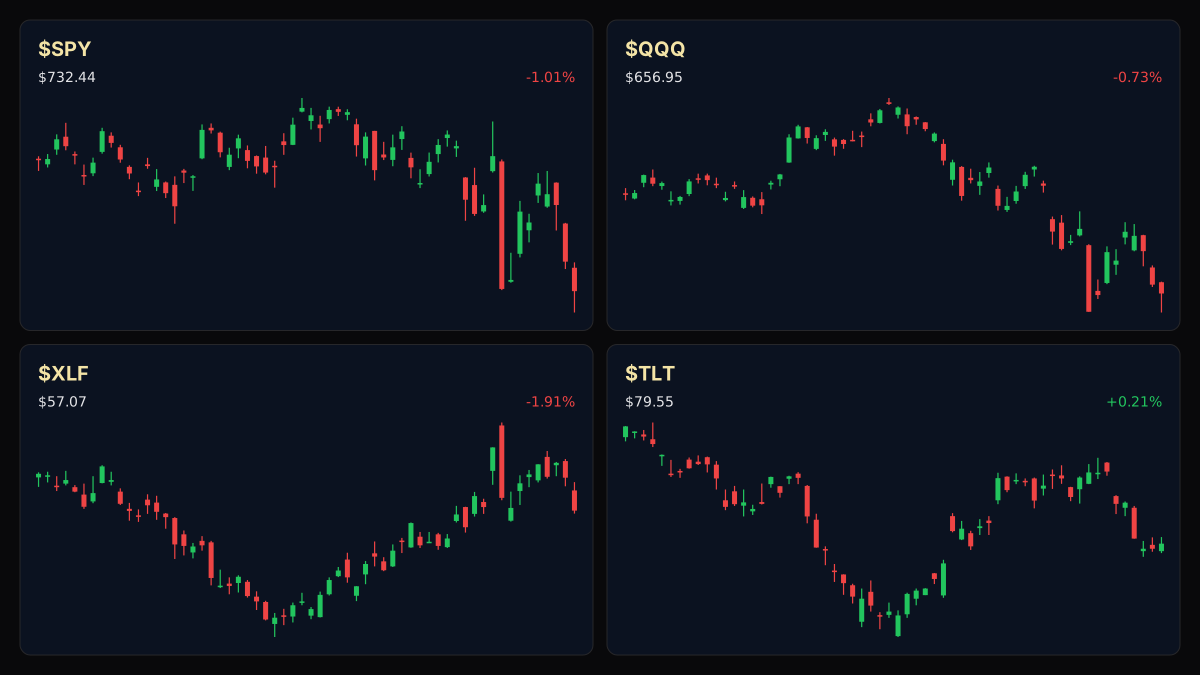
Educational TradingView charts — search any symbol in the widget. Confirm on /markets/SPY and related $QQQ, $TLT, $XLF. Not investment advice.
Related markets
Shares a vertical MP4 loop to your phone's camera roll or app share sheet (Instagram, TikTok, Facebook Reels).
### Money Play Capital concentration in the artificial intelligence build-out continues to tighten broader financial conditions and shift sector dynamics across markets. Investors and traders should observe how elevated borrowing costs impact non-technology sectors and capital allocation strategies.
### Executive Thesis The rapid expansion of artificial intelligence infrastructure has transformed market investment, accounting for nearly two-thirds of investment growth while slowing expansion across other sectors. According to economic analysis, this capital intensity risks driving up electricity and consumer electronics prices while putting upward pressure on interest rates.
### The Print vs Consensus Moody's Analytics Chief Economist Mark Zandi noted that AI investment could reach $1 trillion in 2027, potentially adding about 1% to GDP growth annually while contributing to inflationary pressures. Meanwhile, credit card debt has reached $1.29 trillion, highlighting consumer balance sheet strains as borrowing costs remain elevated.
### Market Reaction Broader economic indicators reflect tightening financial conditions as capital is diverted toward technology and infrastructure build-outs. Economists and market participants continue to monitor whether productivity gains will justify the capital expenditure surge or if slower non-AI growth will weigh on broader equities.
### What It Means for Policy & Positioning The concentration of investment in artificial intelligence presents complex challenges for monetary policy paths and inflation outlooks. With infrastructure spending expected to scale significantly toward 2027, policymakers and market participants must navigate the dual impact of productivity-driven growth and rising cost pressures across the wider economy.
### Next Calendar Watch Observers continue to track upcoming macroeconomic data releases and Federal Reserve commentary for further guidance on interest rate trajectories and inflation trends.
Read the full story
Original reporting and related coverage — attribution links only, not paid recommendations.
Trade this story
 Robinhood
 Webull
 Tradier
 IBKR
Chart this story
 TradingView
Broker and exchange buttons use invite / refer-a-friend links (rewards may be capped). Charting links (TradingView) are partner offers that may pay OppHub America a commission at no extra cost to you.
OppSHOP
Full OppSHOP →As an Amazon Associate, OppHub America earns from qualifying purchases. Shopping here helps keep the site free — at no extra cost to you. Disclosure

OppSHOP
Related to this story
Capital concentration in the artificial intelligence sector continues to
Shop related →

Investing books
Read the classics
Shop this pick →

Personal finance books
Run the household books
Shop this pick →

Trading notebooks
Write the thesis first
Shop this pick →

Monitor for charts
See every pane
Shop this pick →
Story playbook
A pre-built map of what to watch — stocks, ETFs, and educational next steps. Not personalized advice.
Snapshot date: November 17, 2026 at 7:56 PM ET
This playbook was built when the story published and is not live-updated. Prices, news, and risk can change after this date — treat it as a starting map, not a current trade ticket.
Story → money map
AI inflation and interest rates
Building AI data centers costs so much money that it is pushing up overall prices and loan interest rates. Investors care because this boom might hurt other parts of the economy and make borrowing expensive for everyone.
What changed
Economists flagged that aggressive AI capital expenditure is contributing to broader inflationary pressures and higher borrowing costs.
Who wins / who loses
AI infrastructure and tech hardware providers benefit from heavy spending, while debt-heavy non-tech sectors and debt-strapped consumers lose out.
Time horizon
Think in terms of the next few months.
Confidence & best fit
medium confidence · Long-term investor
Safer theme exposure (ETFs)
Baskets that own the theme without betting on one company.
Single stocks (higher risk)
Primary = closest to the story · Peers = same industry · Second-order = knock-on effects · Avoid = looks related but may be a trap
Primary
- $NVDAWatch — track, don’t rush
Makes the main chips for AI, so it gets the big spending money, but could slow down if borrowing costs get too high.
View $NVDA chart → · End-of-day delayed data
Peer
- $MSFTWatch — track, don’t rush
Builds massive computer centers for AI, contributing to the heavy spending boom.
View $MSFT chart → · End-of-day delayed data
Second-order
- $XLUWatch — track, don’t rush
Provides power to massive AI computer centers, which could raise electricity prices.
View $XLU chart → · End-of-day delayed data
Avoid / trap
- $KREStay away — for now
Smaller banks that lend to regular businesses and people could suffer from high interest rates and unpaid credit cards.
View $KRE chart → · End-of-day delayed data
Options (education only)
No strikes or expiries — a framework for how traders might express the view. Options can expire worthless.
Beginners should skip options here because conflicting economic signals make guessing short-term price moves risky.
See options-friendly brokers →Income / OppHub America angle
Not a trade tip — ways to use the insight outside the market.
- Focus on high-yield savings or short-duration Treasuries to benefit from elevated interest rate environments.
What would break this thesis
- Inflation drops significantly allowing the Federal Reserve to cut rates aggressively.
- AI productivity gains outpace capital expenditures sooner than expected, boosting non-tech growth.
What to do next on OppHub America
Saved playbooks stay on this device for now.
Important
Not financial advice. OppHub America playbooks are educational market maps only — not recommendations to buy, sell, or hold any security. Markets move fast; information can be wrong or outdated. Trade and invest at your own risk. Do your own research or consult a licensed advisor.
Based on reporting from yahoo-tickers-tape-movers.
Informational and educational only — not investment, financial, or legal advice. Disclosure
Shares a vertical MP4 loop to your phone's camera roll or app share sheet (Instagram, TikTok, Facebook Reels).