Barry, OppHub America Desk · · Source: yahoo-tickers-tape-movers
Micron Stock Target Cut: UBS Lowers Goal to $1,100
Monitor broader semiconductor sentiment across , , and for spillover effects on capital expenditure cycles and component pricing.
Based on reporting from yahoo-tickers-tape-movers.
Micron Technology (NASDAQ: MU) shares face persistent downward pressure as UBS trims its price target to $1,100 from $1,625 on Tuesday, November 25, 2026, while maintaining a Buy rating. The adjustment follows mounting analyst concerns over potential memory oversupply and moderating artificial intelligence capital spending across the semiconductor sector.
Market context for this story
As of: PremarketLoading quotes…
Informational only — not investment advice. Full markets →


$MUMicron Technology
TradingView
Live chart & market data via TradingView · OppHub classroom · Delayed or exchange real-time per TradingView data agreements · Not investment advice
$NVDA
TradingView
Live chart & market data via TradingView · OppHub classroom · Delayed or exchange real-time per TradingView data agreements · Not investment advice
Educational TradingView charts — search any symbol in the widget. Confirm on /markets/MU and related $NVDA, $MSFT, $TSLA. Not investment advice.
Related markets
Shares a vertical MP4 loop to your phone's camera roll or app share sheet (Instagram, TikTok, Facebook Reels).
Micron Technology (NASDAQ: MU) shares face persistent downward pressure as UBS trims its price target to $1,100 from $1,625 on Tuesday, November 25, 2026, while maintaining a Buy rating. The adjustment follows mounting analyst concerns over potential memory oversupply and moderating artificial intelligence capital spending across the semiconductor sector.
### Money Play - Watch related semiconductor names such as $NVDA+WL, $MSFT+WL, and $TSLA+WL as broader AI infrastructure spending debates influence cyclical sentiment and component pricing forecasts through 2028.
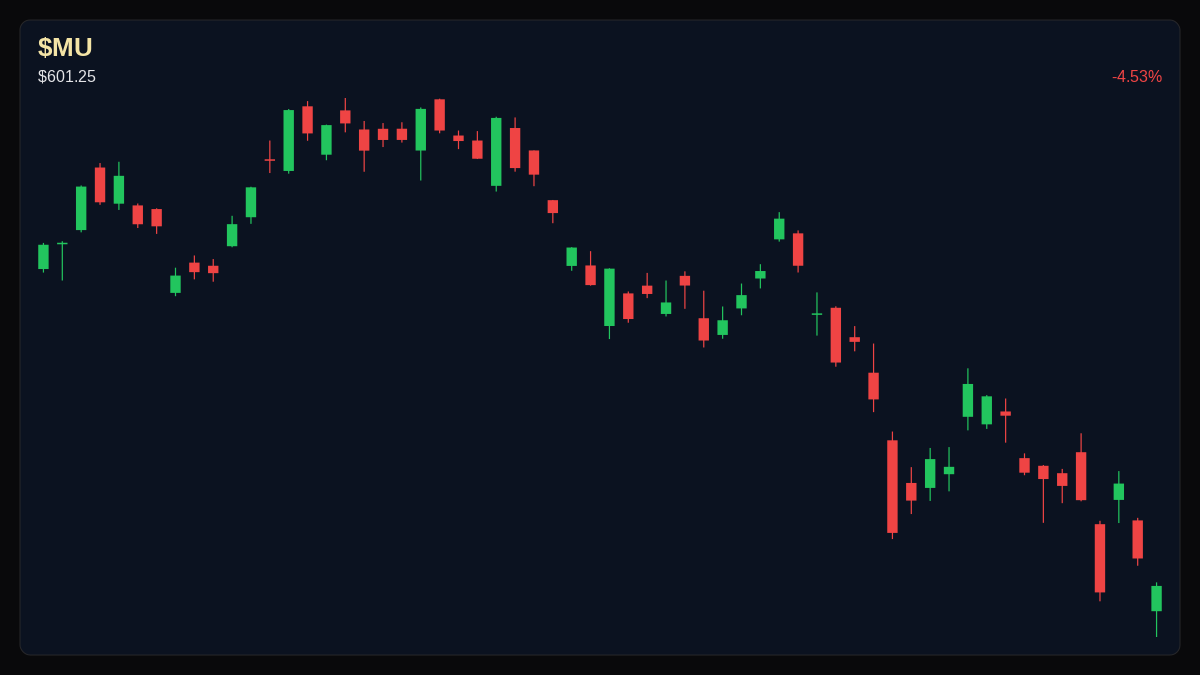
## Catalyst Analysis: Analyst Target Reductions and Supply Pressures UBS analyst Timothy Arcuri reduced his 12-month price target on Micron to $1,100 from $1,625, noting that the stock has retreated 50% from its record close on June 25, 2026. Despite the sizable reduction, the revised target still implies 83% upside from a close of $601.25. The bull case relies on fiscal 2028 consensus normalized earnings per share of $204.99, placing the $1,100 target at 5.4x forward earnings—a multiple sitting slightly above Micron's peak valuations during the 2017-2018 cycle.
Sentiment across the memory market has cooled following a series of cautious analyst notes and sector developments. BNP Paribas Exane downgraded Micron to Neutral with a target cut to $775 from $1,700, citing mounting oversupply risks that could push supply and demand into balance as early as mid-2027. Meanwhile, Goldman Sachs lowered conventional DRAM pricing projections for SK hynix, forecasting a 19% decline in 2028 compared to an earlier estimate of a 5% drop.
To support shareholder value amid multiple compression, Micron plans to accelerate share repurchases starting December 9, 2026. CFO Mark Murphy noted the company's objective to return 100% of excess cash to shareholders over time. However, the viability of the $1,100 valuation target depends heavily on whether consensus estimates hold against projected memory price corrections.
## $MU+WL Technical Analysis & Key Risk Watch
77.54 · R1 ## $MU+WL Technical Analysis & Key Risk Watch 63.20 · last ## $MU+WL Technical Analysis & Key Risk Watch 56.14 · S1 ## $MU+WL Technical Analysis & Key Risk Watch 55.01 · S2 ## $MU+WL Technical Analysis & Key Risk Watch 48.80.
Micron trades 50% below its June 2026 highs, reflecting severe profit-taking consolidation and heightened volatility across memory equities. The current valuation sits at roughly 2.9x projected fiscal 2028 earnings, requiring a multiple expansion toward mid-cycle peaks to validate analyst upside targets. Key risks include sharper-than-expected declines in dynamic random-access memory pricing and potential deceleration in AI infrastructure buildouts that drive high-bandwidth memory demand.
### Sector Ripple / Impact on Semiconductors Shifting capital expenditure expectations for artificial intelligence infrastructure continue to ripple through major hardware developers and enterprise buyers. Changes in projected DRAM bit-growth and pricing dynamics directly influence margin outlooks across memory manufacturers and downstream tech enterprises.
Read the full story
Original reporting and related coverage — attribution links only, not paid recommendations.
Trade this story
 Robinhood
 Webull
 Tradier
 IBKR
Chart this story
 TradingView
Broker and exchange buttons use invite / refer-a-friend links (rewards may be capped). Charting links (TradingView) are partner offers that may pay OppHub America a commission at no extra cost to you.
OppSHOP
Full OppSHOP →As an Amazon Associate, OppHub America earns from qualifying purchases. Shopping here helps keep the site free — at no extra cost to you. Disclosure

OppSHOP
Related to this story
Monitor broader semiconductor sentiment across , , and for spillover eff
Shop related →

Investing books
Read the classics
Shop this pick →

Personal finance books
Run the household books
Shop this pick →

Trading notebooks
Write the thesis first
Shop this pick →

Monitor for charts
See every pane
Shop this pick →
Story playbook
A pre-built map of what to watch — stocks, ETFs, and educational next steps. Not personalized advice.
Snapshot date: November 26, 2026 at 8:01 AM ET
This playbook was built when the story published and is not live-updated. Prices, news, and risk can change after this date — treat it as a starting map, not a current trade ticket.
Story → money map
Semiconductor oversupply and AI spending
A major financial firm cut its expected price for Micron stock because of worries that too many computer memory chips are being made and tech companies might slow down their spending. This makes people cautious about other computer chip companies as well.
What changed
UBS lowered its price target on Micron Technology while noting potential memory oversupply and moderating AI spending.
Who wins / who loses
Memory makers and high-end chip suppliers face downward pressure, while buyers of hardware might eventually benefit from lower component prices.
Time horizon
Think in terms of the next few months.
Confidence & best fit
medium confidence · Long-term investor, Active trader
Safer theme exposure (ETFs)
Baskets that own the theme without betting on one company.
Single stocks (higher risk)
Primary = closest to the story · Peers = same industry · Second-order = knock-on effects · Avoid = looks related but may be a trap
Primary
- $MUWatch — track, don’t rush
Micron's stock is under pressure because analysts worry there will be too many memory chips on the market.
View $MU chart → · End-of-day delayed data
Peer
- $NVDAWatch — track, don’t rush
Nvidia is watched closely because any slowdown in AI spending hurts the whole tech chip sector.
View $NVDA chart → · End-of-day delayed data
Second-order
- $MSFTWatch — track, don’t rush
Microsoft's spending on data centers helps determine how many chips companies like Micron can sell.
View $MSFT chart → · End-of-day delayed data
Options (education only)
No strikes or expiries — a framework for how traders might express the view. Options can expire worthless.
Direction: volatile · Style: Protective put / downside hedge idea · Level: intermediate
Beginners should skip options here. Think of this like buying insurance on a car to protect against a sudden accident.
Income / OppHub America angle
Not a trade tip — ways to use the insight outside the market.
- Review enterprise IT hardware budgets and cloud provider capital expenditure reports for early warning signs of component pricing trends.
What would break this thesis
- Unexpected surges in AI infrastructure demand or sudden supply discipline by major memory manufacturers.
What to do next on OppHub America
Saved playbooks stay on this device for now.
Important
Not financial advice. OppHub America playbooks are educational market maps only — not recommendations to buy, sell, or hold any security. Markets move fast; information can be wrong or outdated. Trade and invest at your own risk. Do your own research or consult a licensed advisor.
Based on reporting from yahoo-tickers-tape-movers.
Informational and educational only — not investment, financial, or legal advice. Disclosure
Shares a vertical MP4 loop to your phone's camera roll or app share sheet (Instagram, TikTok, Facebook Reels).